| |
Humanities & Social Issues |
This area is fairly broad, covering a variety of research projects, publications, conferences in Japan and the UK, lectures and workshops in areas of key importance to both countries. This area includes Japanese Studies.
Examples:
| |
| |
In Japan there is an increasing public awareness of the issue of homelessness and some UK support services, such as the Big Issue magazine, have already been introduced there. A visit to Japan by UK experts, organised by Links Japan, and helped with a grant from the Foundation, enabled these experts to better understand the models of care and inclusion that are taking place in Japan and gave them the opportunity to share best practice with local NPOs working with the homeless and especially with those concerned with the need to develop social enterprise to allow the homeless to earn an income.
 |
|
 |
| © The Big Issue Japan Ltd. |
|
An e-maki scroll drawn by homeless people under the guidance of artist/designer, Geoff Read, who does much work with homeless NPOs. Made for the Japanese Homeless NGO, Moyai’s Fair Trade Coffee project, it brings together words and images by impoverished East Timorese coffee growers with those of Moyai members with an experience of homelessness. |
|
| |
| |
| |
Our grant enabled staff from Essex University's Human Rights Centre to visit Japan to establish a formal, ongoing relationship with several Japanese institutions. Japanese universities do not have advanced human rights centres and curricula, nor do they have current textbooks that cover the broad range of international human rights issues. Essex was able to give much needed support through the compilation and translation of key texts, a series of training programmes and seminars and a two-way exchange of research scholars.
 |
| Professor Jon Packer, Director of the Essex University Human Rights Centre addresses a symposium in Tokyo 'Human Rights Now' with Dr. Sanae Fujita and interpreter Mr. Nakashima. Photo: Akihiro Ueda |
|
| |
| |
| |
The recent re-introduction of trial by jury has put criminal justice in Japan back into the headlines. The Foundation, however, has been supporting research in this important area for some years. Grants to the Institute of Criminal Justice Studies at the University of Portsmouth have supported a wide range of projects including the setting up of an Anglo-Japanese Network for Criminal Justice Studies, a series of workshops focusing on different aspects of the criminal justice systems in both countries, research into gambling in Japan, and joint publications between British and Japanese Researchers. Additionally, a recent grants to Dr Monica Barry at Strathclyde University allowed her to visit Japan to undertake qualitative research on youth offending.

'Koban' a small neighbourhood police station in Japan.
|
| |
| |
| |
Our five-year programme to support Japanese studies in the UK through the creation of 13 lectureship posts at12 universities, now in its third year, is doing much to nurture the future generation of Japan scholars.
We also give regular grant support to young PhD students and postdoctoral fellows wishing to conduct research in Japan. Recent PhD awards have been in areas as diverse as; war studies, shamanism and psychotherapy in contemporary Japanese society, Japan's free trade agreements policy, the sociological study of muji in Japan and in the UK, the political economy of Japan's external energy dependence, Japanese contemporary film, crime and juvenile delinquency, Japan's foreign policy and HIV/AIDS.
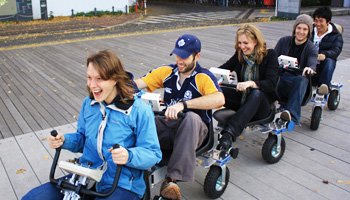
Postgraduates from University of Strathclyde and Tokyo Institute of Technology enjoy a thrilling maiden ride on the Human Driven Snake Vehicle. The students worked on the vehicle under the direction of Professor Hirose of Tokyo Institute of Technology.
|
| |
| |
| |
The current global economic recession is requiring innovative, and cost efficient, responses to providing public services across the world. We gave a grant to the University of Edinburgh Business School for a 10-day research visit to Japan to study public services reform there with the aim of organising an international comparative workshop for senior public policy makers, practitioners and researchers.
|
| |
| |
| |
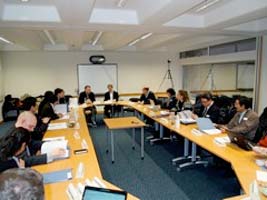
The Foundation is a major sponsor of academic conferences. Recent grant support was given to the Faculty of East Asian Studies, Cambridge University, towards a conference Cold War in East Asia which brought together 25 scholars working in a variety of fields from the United States, France, Korea, Japan, and the UK to discuss the potential for working out new methodologies for the analysis of the Cold War in East Asia. The workshop helped to promote innovative and collaborative research projects that would serve to broaden and deepen understanding of the Cold War by providing a more focused analysis of the perspective of regional actors in northeast and southeast Asia and a corrective to the tendency in past historical work to view the Cold War from an arguably overly US-centric perspective.
|
| |
| |
| |
Our Tokyo Office supported the participation of 11 UK specialists in a Japan-UK Disaster Education Seminar in Kyoto. The visit enabled them to take part in workshops and to exchange views on disaster education with members of the Japanese teaching profession. New and vital networks were forged, with the potential of developing them further in the future. The seminar and study tour did much to help increase public awareness of the need to participate fully in disaster management and reduction.
|
| |
| |
| |
A major grant was awarded to the Asia Pacific Technology Network towards an in-depth study of Japanese Investment in the UK since 1990. Existing literature does not adequately explain how Japanese investment evolved, as the bubble economy collapsed, investments matured, and competition from cheap labour locations elsewhere developed. The study began with the production and dissemination of a 15,000 word pamphlet and continues with a book-length history of Japanese corporate investment in the UK since 1970.
|
|

 Back to Top