
Making a Difference
The Great Britain Sasakawa Foundation accepts applications for UK-Japan relations and exchange in the fields of: Arts and Culture; Humanities and Social Issues; Japanese Language; Medicine and Health; Science, Technology and Environment; Sport; Youth and Education. A full list of awards given each year can be found in our Annual Reports. Examples of projects we have supported include…

Made with Nishijin kimono material using genetically engineered silk developed by scientists at the National Institute of Agrobiological Sciences, Sputniko!’s ‘Tranceflora’ combines traditional craftsmanship with advanced technology to mesmerising effect. The luminous silk is created by adding the genes of glowing jellyfish and coral to silkworms, woven by master weavers at HOSOO textiles, Nishijin, Kyoto, and fashioned into a dress designed by Masaya Kushino. This piece was exhibited as part of this Victoria & Albert Museum event, supported by the Foundation.
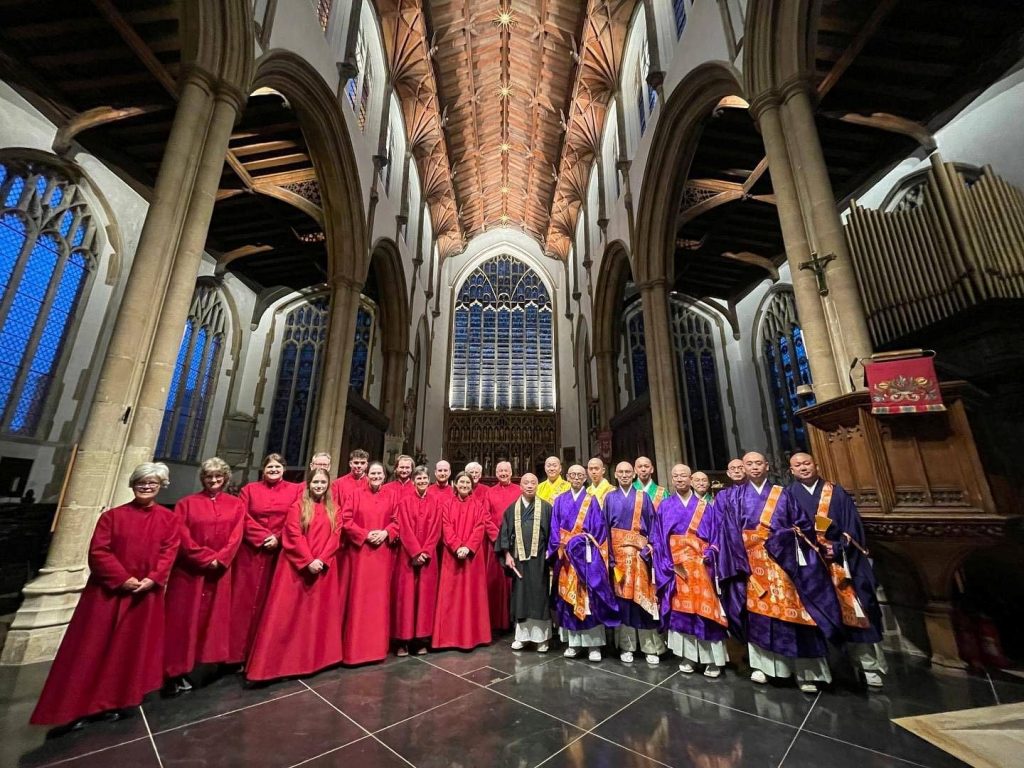
Twelve Buddhist monks of the Shingon sect from Hasedera temple in Nara visited Norwich and introduced the sacred Buddhist chant known as Shōmyō as part of the Norfolk & Norwich Festival to commemorate the 25th anniversary of the Sainsbury Institute for the Study of Japanese Arts and Cultures. In addition, a full-size replica of the gigantic hanging scroll depicting the bodhisattva Kannon was exhibited in the atrium at The Forum in the city centre, captivating many visitors. Hasedera Temple has since produced a multilingual website for international visitors.

The Clifton Scientific Trust has been running its UK-Japan Young Scientist Workshop Programme since 2001 and the Foundation has given the initiative regular support. School students from the UK and Japan take part in joint science and engineering workshops held at the University of Cambridge and at a Japanese university. They conduct experiments together before presenting their findings to an invited audience. The impact on the students is enormous, building personal as well as academic confidence through teamwork and cultural exchange.

2015 was the 70th anniversary of the dropping of the atomic bomb on Hiroshima and the London Bubble Theatre Company marked it through a special oral history and performance project, ‘The Grandchildren of Hiroshima’. Interviews between A-bomb survivors and local children were conducted and recorded and our grant helped fund workshops that developed these interviews into a theatrical production. The project culminated in performances in Hiroshima in August 2015 that featured community participants aged between 8 and 80, emphasising the company’s intergenerational approach and incorporating the experiences of survivors, as told through the perspective of children today.

Our funding supported a fieldwork visit by the University of Aberdeen, in collaboration with the National Institute for Environmental Studies, Tsukuba, to collect rock and fossil samples in Yamaguchi Prefecture. The rocks were deposited at the time of an abrupt period of global warming in the Jurassic era and analysis of these samples will help to determine the extent, timing and duration of this hyperthermal event. Both institutions are planning further collaboration and publications with additional fieldwork that will gather more samples from an area rich in fossil material.

We were pleased to award funding to a team from Swansea University’s College of Engineering for a collaboration with Tsukuba University using 3D motion capture technology to study goal kicking in rugby. This was the first time any Japanese university had scientifically analysed a technical aspect of rugby, with the findings already proving of interest to the international rugby community as well as to international researchers of biomechanics in sports. The project not only helped to develop a new research partnership between the UK and Japan but also offered a new perspective through applying science and technology to a sport that is increasing in popularity in the country that hosted the Rugby World Cup in 2019.